Hello! Most of my posts take place around San Diego County, (Mostly Lake Murray) unless otherwise noted.
For more posts and photos, I also post on Hubpages, a site that is a bit different than others. Thanks!: Shorebirdie on Hubpages
Showing posts with label grackles. Show all posts

Monday, August 9, 2010

More ducklings! Update on Fish Food Ducklings

I made an extended version of the Fish Food ducklings slideshow:


Today, I think I saw all three of those ducklings plus their mom. They are about 9 1/2 weeks old now.

Peaches


Caramel


I think this is Butterscotch, but could be one of the Hawk Food ducklings who have been missing for a while. However, she shares many characteristics of her supposed mom and sisters, that I think it might be her. I thought I saw Butterscotch in another area of the lake, but she could have swam to this spot while I was walking there.


Here is a little 5 to 6 week old that I think is a survivor of the six ducklings that disappeared after July 4th.


Remember this little guy? This might be the duck above:


And, I saw another little duckling, probably less than a week (about 5 days) old:


Sir Francis' leg is doing really well.


No sign of the other injured duck. Maybe he is doing better.

Killdeer Update:

George and Martha were missing both times I passed through their territory. 7 killdeers were in the ballfield, but no sign of any chicks making their debut, yet. The killdeers in the ballfield were super quiet, you wouldn't even know if they're there if you didn't see them.

Also seen:

I gave the ducks some Crisp Rice, but the grackles got most of it, instead, and were feeding it to some babies.


It was all quiet in George and Martha's territory and this guy is the reason why:

Male Cooper's Hawk


He even scared the ducks even though they're too big for him. A juvenile red-tail hawk was sharing the area, also, probably because he wanted to steal the Cooper's hawk's food.


And, I thought this was a cute photo:

A wood duck and a female mallard in the sun.

Friday, June 18, 2010

Sign of the end of killdeer breeding season?

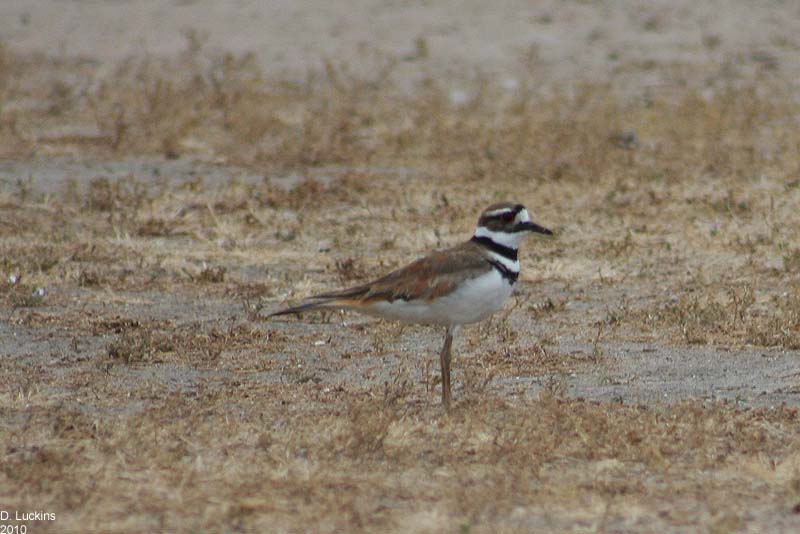
Female killdeer stretching her wings

When I last visited the lake, I originally found what I thought was three or four killdeer in one area of M2's territory. I wasn't expecting (or hoping) to find any killdeer at all because M2 should have been attending to a nest in his nesting area. But, something must have happened to that nest. Three of the killdeer looked like M2, M3 and possibly M5, whom I've also seen fighting over females elsewhere. I spotted an unknown female with those three, but it could be F2, Little Male's "stolen" mate.

3 male killdeer and one female on the left

When I walked ahead, I found another female, F1 (M3's mate) getting harassed and pecked by the grackles trying to eat the duck food someone had left.

F1 (M3's mate)?

The males were making various gestures towards each other such as dipping and tail flashing. I've noticed that if a male turned his back and dipped, he was basically left alone. However, if he turned toward another male and dipped, he risked being attacked, especially if he flashed his orange tail feathers at the other male. There was also a lot of calling, trilling, and angry trill-calls, probably from M2. It almost sounded like roosters arguing.

The females just walked around, preening and feeding, ducking the grackles who flew right over their heads, almost hitting them.

On the other side of the peninsula and the lake parking lot, F3 and Little Male were all alone. F3 showed almost no fear of me and pretty much let me walk up to her without getting upset.

F3 being dominant and unfraid

However, Little Male was acting like a big baby, acting very submissive and hiding. Even when I had walked very far away, he still flatted himself and trilled. F3 came up to him, seeming to comfort him, but it still took him a while to stop. I've seen males act this way around females while in their feeding areas, but he was really going all out. But, that's his personality, he always over-acts. This may be due to his young age.

M1 (Little Male) being submissive and calling

M4 was all alone, but again losing his voice. I spotted M7 guarding his area, too.

When I came back, I wanted to make sure none of the killdeer had gotten hurt or killed by any grackles because a couple of them were getting pecked at earlier. All the grackles were over in Little Male's territory and he was all alone, trilling as I walked by. But, they didn't seem to be bothering him.

In M2's territory, all was very, very quiet. It was kinda nice, not a grackle in sight. I thought it was because there were fewer people or because the food was gone. Not even the phoebes were flying around. The killdeer were there, this time there were six of them because F3 had joined them, but they were totally quiet. A couple of the females foraged, but most of them were very quiet and very still. This wasn't unusual as it's often their way of hiding from predators. They totally blend into the environment this way.

As I was beginning to leave the area, I saw a cooper's hawk fly to the trees. A killdeer screamed at almost the same time it flew over, but I thought it was because someone's child scared it away. This could have been a fatal mistake if it was ten seconds earlier as cooper's hawks often hunt by causing panic to a flock of birds to get them to fly off into the air where they can get snagged. But, this hawk wasn't hunting the killdeer, it flew over closer to where the grackles were hanging around. I don't think it had a target that time, just checking out the area for possible prey and hunting strategy. So, the male that flew off (I think it was M3 going back to his territory), was safe that time. All the other killdeer continued to stay very quiet and still. Let's hope that none of my killdeer friends make this mistake again.

I had a feeling that the abundance of grackles in the area might attract bird hawks. But, one thing about hawks, you know they're hunters and the killdeer and phoebes know they're hunters, so they're not going to let their guards down when they know they're around.

I'm wondering if this sudden gathering of all the neighboring killdeer signals the end of the breeding season. The males were still displaying to each other, though, so this may be a way to "regroup" and select new mates and territories. Little Male didn't seem to want any part of being in this group. I think it may have to do with him picking fights with two of the males and getting that bruise on his chest. Like I've said before, he's very young and perhaps three older males together seem too intimidating to him.

Tuesday, June 15, 2010

Killdeer Update, M2 and F3 "missing"

M1, Little Male, in an area where seed is given to the doves. M1's sore on the front of his chest has healed.


I couldn't find any sign of M2 or his mate today. At one time, I thought I heard an alarm and territorial call from him when M1 was forced to cross the lake by someone walking their dog. But, I think it might have been my ears playing trick with me. I didn't see him when I got to the lake and I didn't see him when I came back. I haven't heard or seen of any headless bird bodies, so it's unlikely that the grackles got him. The grackles have actually been behaving reasonably well towards the other birds (and people) so far. So, it's very likely that M2 is in his nesting area with his mate and eggs.

I've noticed that killdeers have two parts to their territories: a feeding area (where they are most of the time) and a nesting area that is usually within sight of their feeding territory. This may be an adaptation to living with "smart" predators like crows, grackles, and ravens who watch the habits of the birds whose babies or eggs they eat. The males spend most of their time in their feeding area, only visiting their nesting area once in a while to "show" the nesting site to a prospective mate and to check on it's current safety level. After the chicks hatch, they may or may not bring them to the feeding area depending on how safe the parents feel that area is. That is probably why killdeer families "disappear" after the first day or two after they hatch. The family is brought to a "feeding area".

I still have not found where M2's nesting area is. It's undoubtedly within sight of his territory, but that could me a mile away on the other side of the lake. I am hoping that by the time the chicks are a day old, most of the grackles will be done nesting and be out of the area or in fewer numbers. But, it appears that some of the grackles are building new nests, including a pair in M4's area. However, I think that pair may disperse when the ravens decide to return to the area. Grackles do hang out with other blackbirds, but I don't think they like ravens and crows, especially when they're outnumbered. If I start seeing F3, M2's mate, more frequently in the future, I am going to assume that their nest was a failure.

Speaking of M4, I don't exactly know where his nesting area is, but I have a suspicion that it's in the area with the grackles. If the grackle number stays low (1-4 individuals), the killdeer may be OK and not be bothered. But, I think it's more likely that the nesting area is in M7's area as M4 is constantly "watching" that area and fighting off other males who try to take residence there.

Today, M4's voice was nearly gone. He could hardly call above a whisper. He seemed very nervous while I was there and was having such a hard time with his voice that I thought I should leave so that he could get his voice back. No sign of "Bo" anywhere.

I thought I heard a killdeer in the M8 area today doing an alarm call. It's hard to tell because there's so many finches and phoebes making a lot of noise that it was hard to tell. I didn't go and check it out. Chances are that it's the "Deets", but it could be M2 as the "Deets" showed up in this area last time M2 was missing (though the "Deets" looked and acted like totally different killdeer, maybe they could actually be M2 and F3 all puffed up or something). Killdeer behavior does change when they are in their breeding areas, mostly with more nervousness and defensiveness.

Monday, June 14, 2010

Grackles and Killdeer Chicks

Great tailed grackle in tree

Lake Murray has a large population of great-tailed grackles. They have pretty much taken over the lake and are heavily concentrated in M2's territory. That could be why M2 and his gal have been fighting with Little Male over the south side of the territory--to find a safe place for their chicks. But, Little Male won't give up his feeding grounds that easily. Also, it's not all that safe, grackles sometimes go there along with a few crows and small raptors.

So far, I haven't seen any really bad behavior on behalf of the grackles except for one time when they tried to steal food out of M2's mouth. I think he gave the grackle a sharp peck with his beak, but otherwise seemed unworried about the big black bird, who backed off. It's possible that the grackle didn't get more aggressive because I was there, or it felt like it wasn't worth it. But, M2 seemed pretty much unconcerned about the bird. I have heard about grackles killing an adult killdeer, but I haven't seen any real aggression between the two species yet. (I did see a grackle aggressively harass and peck heavily a large white-winged dove at a Borrego Springs bird feeder recently for no apparent reason).

However, I am almost 100% positive that the grackles will eat any of the killdeer chicks that might be running around that area. While I do think the killdeer could defend itself pretty good if it was alert and ready for a grackle attack, I fear that the grackle will actually kill a parent to get to a chick.

So far, I haven't seen any harm come to ducklings as they are mostly ignored by the grackles. I don't think the mother ducks like them and that could be why they moved them out of that area quickly. The family of five used to hang out near the grackle nesting area when the ducklings were very young until the grackle chicks started to fledge.

M2 avoids being near the grackle nesting area, now very busy with fledging chicks. He used to go over to that area a lot, but has since stayed away as about a dozen of them are nesting in the trees there. Hopefully, the grackles won't be territorial when it comes to their fledgelings and my fears of one of them killing M2 or his mate may come true.

I am sure that F3, M2's mate, has already laid her eggs (they mated a week ago), but perhaps in another male's territory. M2 was calling her last time I saw him, but there was no sign of her. M1 has a "safer" area to nest in but people walk around that area and sometimes a hawk comes by. M4 has ravens firmly established in part of his territory. I haven't seen M8 in a while. M6 and M7 may have safe nesting spots, but I have seen no breeding activity in those areas except for the fights over a female.

It would seem that only M3 and M5 (the ones living in a fenced off area near the treatment plant) have the safest nesting area with few grackles, hawks, crows or ravens. But, I can't see them, so it looks like I won't be able to see or photograph any killdeer chicks at the lake this year or even the next few years if the grackle population stays high.

Strangely, there have been few true large blackbirds at Lake Murray recently. They used to be extremely common there until recently.

So, will the rise of the grackles mean the demise of the killdeer or other birds in the area?